


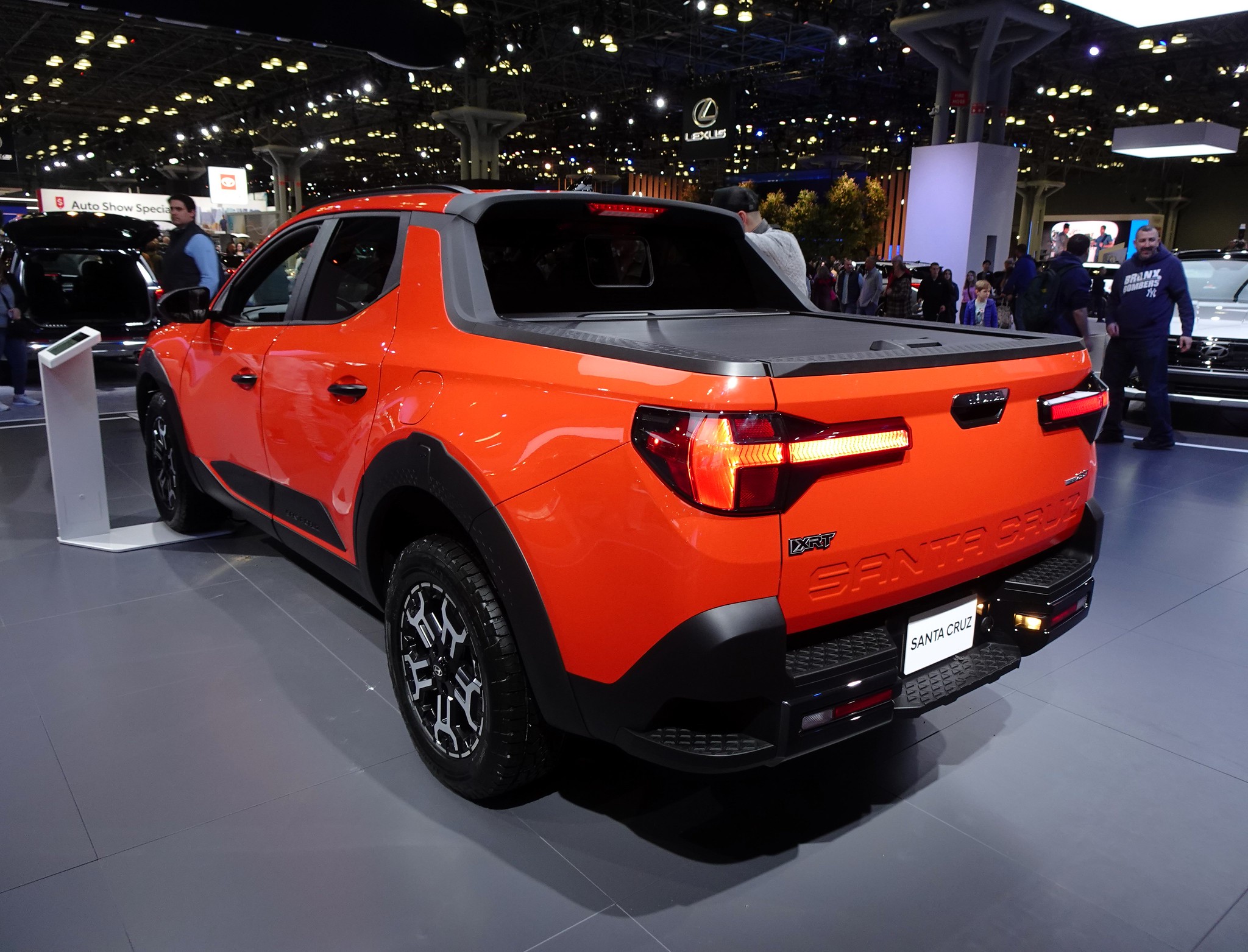
The Hyundai Santa Cruz and Hyundai Tucson are excellent choices for buyers who are looking for safe vehicles. The Santa Cruz received the Top Safety Pick award from the IIHS, and the Tucson received the Top Safety Pick+ award.
Standard Safety Features: Which Vehicle Offers Better Protection?
Hyundai Santa Cruz XRT (2024) by Charles is licensed by CC BY 2.0
The Santa Cruz and Tucson come with comprehensive lists of safety systems and advanced driver aids. Here’s a closer look at how these two Hyundais compare when it comes to safety.
Hyundai SmartSense Safety Suite Comparison
The Santa Cruz and Tucson come standard with Hyundai’s SmartSense suite of advanced driver aids. This bundle includes several safety systems, including:
- Forward collision-avoidance assist with pedestrian detection
- Blind-spot collision-avoidance assist
- Lane keeping assist and lane following assist
- Blind-spot view monitor
- Lane keeping assist
- Driver attention warning
- Forward attention warning
- Automatic high beam headlights
- Lane following assist
These safety systems are designed to keep the driver aware of their surroundings. They use visual and audible alerts to provide warnings about potential hazards, and will take preventative action if needed.
Advanced Driver Assistance Systems (ADAS)
In addition to the standard driver assistance systems, these Hyundai models offer additional advanced driver aids.
- Highway driving assist
- Safe exit warning
- Rear cross-traffic collision-avoidance assist
- Smart cruise control with stop and go
The Hyundai Tucson also offers advanced driver assistance to make driving safer and more convenient. Some of these systems include:
- Navigation-based smart cruise control with curve control
- Surround-view monitor
- Rear occupant alert
- Advanced rear occupant alert
- Remote smart parking assist
- Parking collision avoidance assist
Passive Safety Features
The Tucson and Santa Cruz come equipped with long lists of passive safety systems in addition to the driver aids. The Tucson has airbags throughout the cabin, including two front, two front side, and two side-curtain airbags. There are also two rear side airbags.
The Santa Cruz also comes with eight airbags in the same places as the Tucson, but the rear side airbags have rollover sensing features.
Both vehicles are constructed from high-strength steel and have unibody designs. No matter which of these Hyundais you choose, the vehicle stability management system comes standard, and you’ll benefit from electronic stability control with traction control to help you avoid losing control when the driving conditions become slippery.
Real-World Safety Performance Analysis
The Hyundai Santa Cruz received high marks from both the NHTSA and the IIHS, and the Tucson is a Top Safety Pick+ according to the IIHS, which is their highest rating.
Crash Test Performance Breakdown
The high crash test scores for the Tucson and the Santa Cruz will give you confidence when you get behind the wheel and put your loved ones in your vehicle.
According to the IIHS, the Tucson received “Good” ratings in all the crashworthiness testing. This includes small overlap front, moderate overlap front, and side crash.
The National Highway Traffic Safety Administration gave it five stars for its overall safety rating and the side crash rating. It received four stars in the rollover resistance rating.
The Santa Cruz ratings are not as high as the Tucson ratings, but they are still impressive. It received a “Good” rating from the IIHS in the small overlap front test and “Good” ratings for moderate overlap front and the side crash test. The overall rating from the NHTSA is five stars.
Vehicle Stability and Handling Safety
When you head out on the road in the Tucson or Santa Cruz, you’ll be ready for any road conditions, with safety systems to help.
Electronic stability control (ESC) comes standard with both of these Hyundai vehicles. This system is designed to help prevent skidding when roads become slippery, wet, or icy. Traction control works along with ESC to keep the wheels from spinning so you can maintain grip when accelerating or driving on slick roads.
Size and Design Impact on Safety
The Tucson and Santa Cruz are built on the same platform, but the Santa Cruz is a foot longer, and it is slightly wider. The size difference between the two does not impact safety performance.
Since both of these Hyundai vehicles have similar safety equipment, they offer similar protection for their passengers. One of the most significant differences is that the Santa Cruz has an open bed compared to the enclosed cargo area of the Tucson, but this doesn’t impact safety.
Safety Technology and Innovation Comparison
The Santa Cruz and the Tucson offer similar safety technology. Both use cameras and sensors to detect nearby vehicles and obstacles. Also, they have automatic braking systems that can apply the brakes if needed to help avoid collisions.
The Hyundai Blue Link+ connected services system offers drivers added convenience and safety. It works with the MyHyundai app to turn your phone into a remote starter for your vehicle.
Use BlueLink+ to check your gas level right from your phone, or get reminders about when it’s time for an oil change with the app.
Insurance and Safety Cost Considerations
Since the Tucson and Santa Cruz have similar safety features and equipment, they will have a similar impact on insurance costs. Insurers use safety ratings and features to calculate the cost of insurance, but other factors also affect insurance rates.
It’s Time to Choose Your Hyundai
Now that you know more about the safety features available with the Hyundai Tucson and the Hyundai Santa Cruz, and how they compare, you can make an informed decision about which one is right for you.
Come to Titus-Will Hyundai to see both vehicles and even take one of each out for a test drive. Our team is here to answer any questions you have about the safety features and ratings.
Connect with us


Categories
Titus-Will Hyundai

Address
2255 Carriage Loop SW
Olympia, WA 98502
Phone
| Monday | 9:00AM - 8:00PM |
| Tuesday | 9:00AM - 8:00PM |
| Wednesday | 9:00AM - 8:00PM |
| Thursday | 9:00AM - 8:00PM |
| Friday | 9:00AM - 8:00PM |
| Saturday | 9:00AM - 7:00PM |
| Sunday | 10:00AM - 6:00PM |
| Monday | 7:00AM - 6:00PM |
| Tuesday | 7:00AM - 6:00PM |
| Wednesday | 7:00AM - 6:00PM |
| Thursday | 7:00AM - 6:00PM |
| Friday | 7:00AM - 6:00PM |
| Saturday | Closed |
| Sunday | Closed |
| Monday | 7:00AM - 6:00PM |
| Tuesday | 7:00AM - 6:00PM |
| Wednesday | 7:00AM - 6:00PM |
| Thursday | 7:00AM - 6:00PM |
| Friday | 7:00AM - 6:00PM |
| Saturday | Closed |
| Sunday | Closed |